
The Last Evening
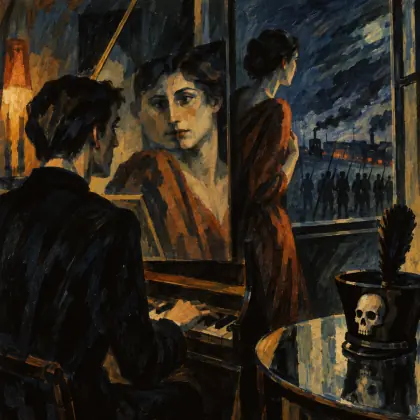
And night and distant rumbling; now the army's carrier-train was moving out, to war. He looked up from the harpsichord, and as he went on playing, he looked across at her almost as one might gaze into a mirror: so deeply was her every feature filled with his young features, which bore his pain and were more beautiful and seductive with each sound. Then, suddenly, the image broke apart. She stood, as though distracted, near the window and felt the violent drum-beats of her heart. His playing stopped. From outside, a fresh wind blew. And strangely alien on the mirror-table stood the black shako with its ivory skull.
The Last Evening - meaning Summary
Projection Before Wartime Parting
Rilke's 'The Last Evening' portrays a brief domestic scene before a soldier's departure. A man plays the harpsichord while seeing his own features reflected in the woman's face, a projection that intensifies with the music. The fragile intimacy is shattered: she becomes distant, his playing halts, and the external realities of war intrude, symbolized by a black shako with an ivory skull on the mirror-table.
Feel free to be first to leave comment.