
Analysis of I Carry Your Heart With Me
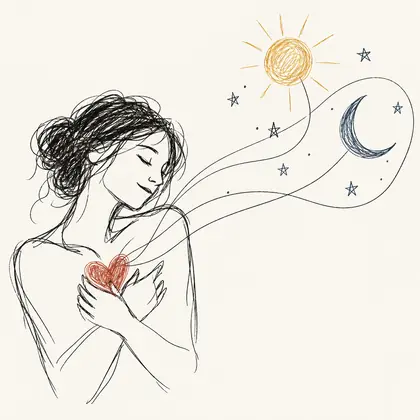
Love as a shared self, not an added person
Cummings’s central claim is audaciously simple: to love someone is to have your own identity re-made around them, so completely that the boundary between two people becomes hard to locate. The poem opens with a declaration that sounds like devotion but quickly becomes ontology: i carry your heart with me
, not as a metaphorical keepsake but as something literally housed in my heart
. The speaker doesn’t describe longing, absence, or yearning; instead he insists on a steady condition—i am never without it
—as if separation is no longer a meaningful category.
The tenderness of possession, the risk of erasing the self
That steadiness carries a tension. The poem is intensely intimate, full of endearments—my dear
, my darling
, my sweet
, my true
—but it also makes a claim that could sound frightening if it weren’t sung so gently: whatever is done
by the speaker is also your doing
. Love here is not just companionship; it is a kind of merged agency. The parentheses amplify this double feeling. They read like whispered asides tucked inside the main sentence, yet what’s inside them is the most absolute content, as if the poem can only say this much closeness by half-hiding it.
Defying fate by surrendering to it
The poem’s emotional pivot arrives with the line break and the small cliff of i fear
, which immediately resolves into no fate
. But the reason for fearlessness is paradoxical: for you are my fate
. Fate is usually what happens to you from the outside; the speaker reframes it as the beloved’s presence within him. The same logic governs i want no world
because you are my world
. These are not casual compliments; they are replacements. The beloved doesn’t decorate life; she becomes the scale by which all life is measured, so that the normal objects of desire—security, a future, a larger world—are declared unnecessary.
Moon, sun, and a cosmos resized to one person
Cummings raises the stakes by moving from the private body to the sky: whatever a moon
has meant and whatever a sun will sing is you
. The moon suggests enduring human meanings—change, longing, romance—while the sun suggests necessity, warmth, and the daily song of being alive. By claiming both, the speaker makes the beloved a complete universe: not one symbol, but the whole set of symbols by which people have tried to speak about wonder. The tone is rapturous but not vague; it is specific in its insistence that the oldest, most impersonal lights in existence have always been pointing toward this one relationship.
The deepest secret
said out loud
The second stanza begins like a confession—here is the deepest secret
—and that word secret introduces a new contradiction: the speaker announces what nobody knows
in the very act of telling us. What follows is a cascade of origins—root of the root
, bud of the bud
, sky of the sky
—as if love is not merely an emotion but the generative principle behind life’s growth, the hidden core of a tree called life
. Yet even this cosmic claim returns to humility: the tree grows higher than the soul
can hope or the mind can hide, suggesting that love exceeds both spirituality and intellect. The final wonder—keeping the stars apart
—makes intimacy into a force of cosmic order: love becomes the spacing that prevents collapse, the invisible law that lets beauty exist without swallowing itself.
A closing loop that feels like a vow
When the poem ends by repeating i carry your heart
(again nestled within parentheses), it doesn’t feel like mere repetition; it feels like returning to a touchstone after traveling through fate, world, moon, sun, roots, and stars. The tone resolves into calm certainty, as if the speaker has tested his claim against everything vast and found it still true. The most startling thing the poem insists on is this: the beloved is both the smallest location (a heart) and the largest (a cosmos), and the speaker lives inside that contradiction as if it were the most natural home.
It is a beautiful poem that I often recite to remind myself how blissful love can be with your soul mate.