
The Solitary Reaper
Behold her, single in the field, Yon solitary Highland Lass! Reaping and singing by herself; Stop here, or gently pass! Alone she cuts and binds the grain, And sings a melancholy strain; O listen! for the Vale profound Is overflowing with the sound. No Nightingale did ever chaunt More welcome notes to weary bands Of travellers in some shady haunt, Among Arabian sands: A voice so thrilling ne'er was heard In spring-time from the Cuckoo-bird, Breaking the silence of the seas Among the farthest Hebrides. Will no one tell me what she sings?-- Perhaps the plaintive numbers flow For old, unhappy, far-off things, And battles long ago: Or is it some more humble lay, Familiar matter of to-day? Some natural sorrow, loss, or pain, That has been, and may be again? Whate'er the theme, the Maiden sang As if her song could have no ending; I saw her singing at her work, And o'er the sickle bending;-- I listened, motionless and still; And, as I mounted up the hill, The music in my heart I bore, Long after it was heard no more.
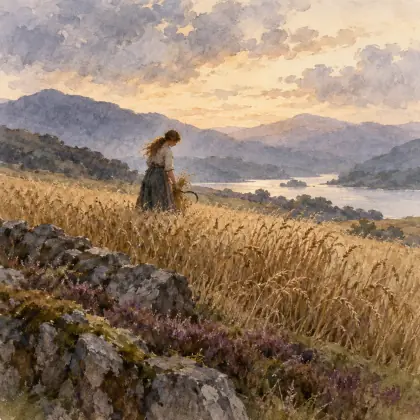
The Solitary Reaper - context Summary
Inspired by 1803 Tour
Context: Wordsworth composed "The Solitary Reaper" after observing a Highland woman during his 1803 tour of Scotland with his sister Dorothy and Samuel Taylor Coleridge. Written in 1805 and published in Poems, in Two Volumes (1807), the poem records a moment of lyrical attention: the poet pauses, listens to a solitary singer at work, and carries her music inward. The poem frames personal encounter as the source of lasting imaginative affect.
Feel free to be first to leave comment.