
Leda and the Swan
A sudden blow: the great wings beating still Above the staggering girl, her thighs caressed By the dark webs, her nape caught in his bill, He holds her helpless breast upon his breast. How can those terrified vague fingers push The feathered glory from her loosening thighs? And how can body, laid in that white rush, But feel the strange heart beating where it lies? A shudder in the loins engenders there The broken wall, the burning roof and tower And Agamemnon dead. Being so caught up, So mastered by the brute blood of the air, Did she put on his knowledge with his power Before the indifferent beak could let her drop? September 1923
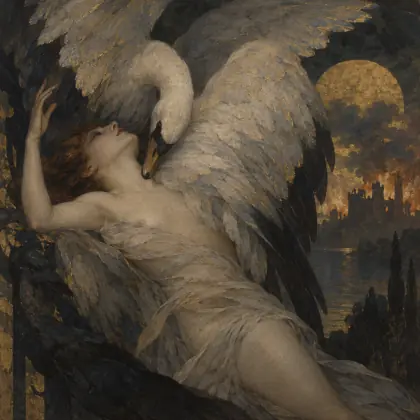
Leda and the Swan - context Summary
Composed 1923, in the Tower
Yeats retells the mythic rape of Leda by Zeus-as-swan in a tight, violent scene that compresses physical violation and its far-reaching consequences. The poem links a private, shocking act to dramatic historical outcomes, suggesting a moment when violent instinct produces irreversible cultural and political change. Written amid Yeats’s anxieties about Irish history and artistic direction, it appears in his collection The Tower (1928) and reflects the poet’s concern with historical rupture.
I heard he was asked to compose a poem by a political magazine but felt that the soil was so exhausted by the demagogic, individualist movement from Hobbes through the French Revolution, that nothing was possible now except a movement from above preceded by some violent annunciation. This was 1922 so the First World War was over, but the unfettered, mass violence of the second world war lay ahead. I have never heard about the British empire specifically. I think he said that when he got deeply into the story, all politics left his mind.
I am curious if anyone else thinks Yeats may have used this specific myth for dual purpose of what swans symbolise in the UK and Ireland, as all swans in the UK belong to the reigning monarch. Intentional or not, Yeats' genuine fears of his countries security was likely fueled by the actions of The British Empire, which at the time, I could imagine, was seen as an almost Godlike force in its power, reach and (as reflected in Greek mythology specifically,) complete curroption and abuse of powers. I would be interested to hear other people's thoughts on this perspective, as it only occured to me after several reads. Thanks ☺️